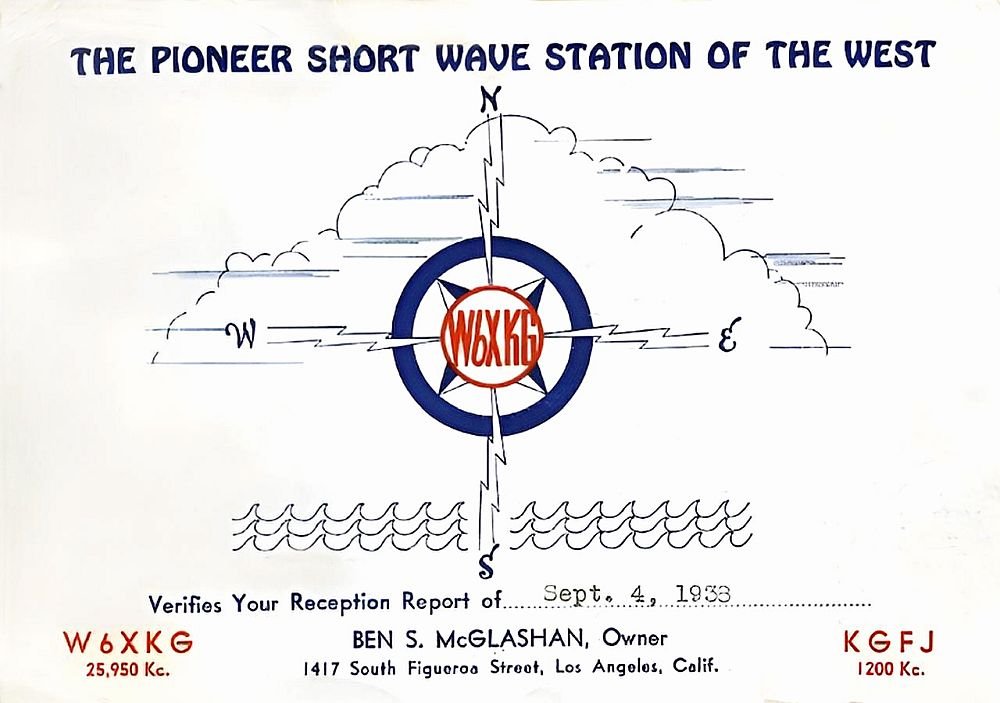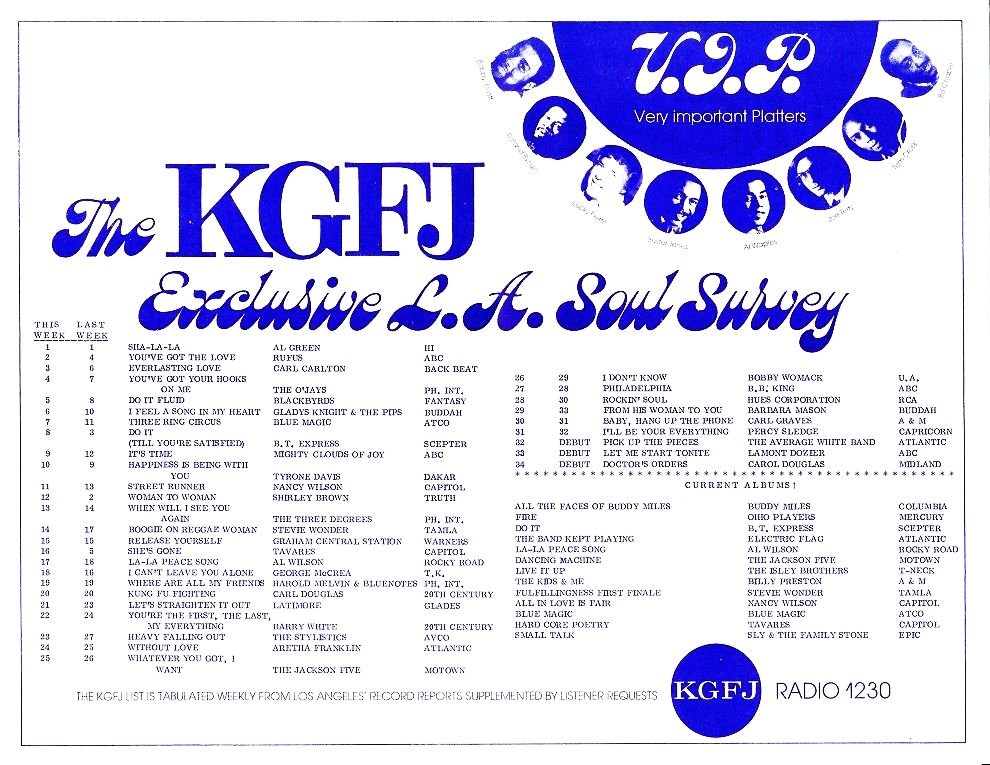
KGFJ Los Angeles -
The Original 24-Hour Station
By Jim Hilliker © 2016, Updated 2024
With edits by John Schneider
|
|
KGFJ Los Angeles - By Jim Hilliker © 2016, Updated 2024 |
|
www.theradiohistorian.com Copyright 2023 - John F. Schneider & Associates, LLC (Click on photos to enlarge)
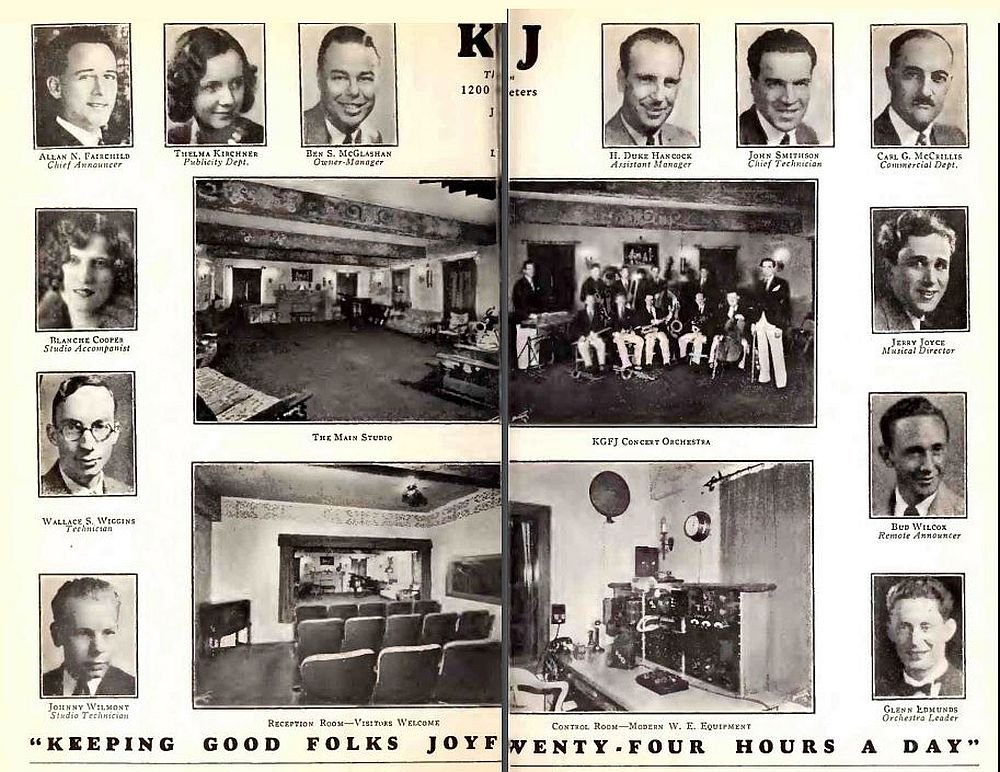
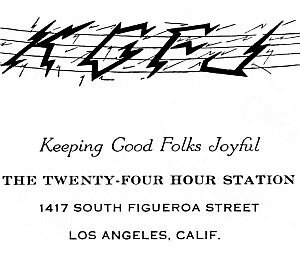
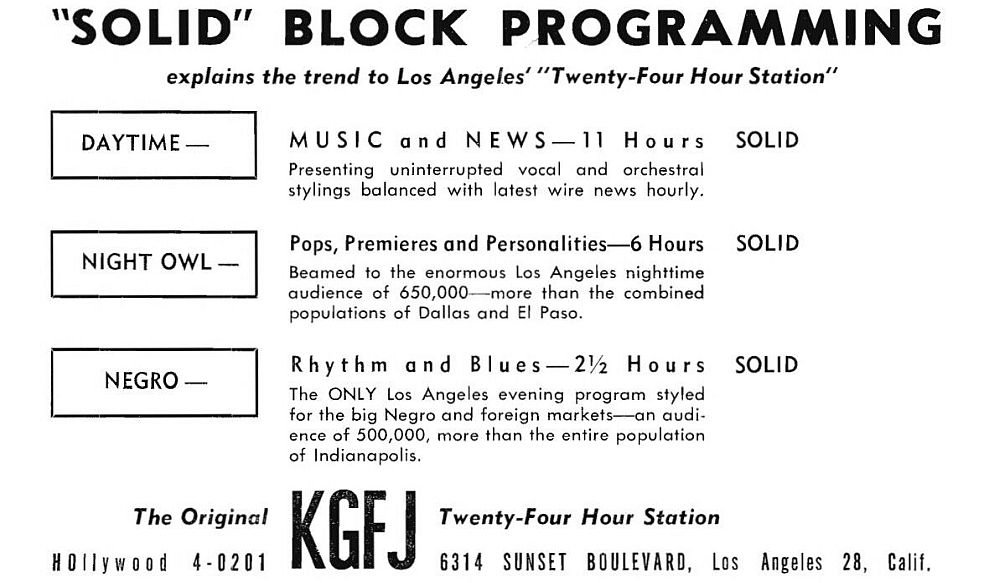 This advertisement from the mid-1950's describes KGFJ's programming at that time.
|
|
Introduction Today, we take for granted the fact that
our favorite radio stations will be on the air all day and all night. Because we
now live in a society that is more connected to a 24/7, around-the-clock lifestyle
than ever before, it's hard to comprehend that at one time this was not always the
case. In broadcasting's infancy, finding a radio station on the air past midnight
was a rare occasion! It was in November of 1927 that a U.S.
radio station first decided to broadcast during the "all-night" hours
after midnight on a regular basis. A handful of stations did it on an irregular
basis prior to 1927. WDAF in Kansas City
may have stayed on the air for 24 hours in 1922. It broadcast the Coon-Sanders Original Nighthawk
Orchestra starting in late-1922, but it usually went off the air at 1:00 AM. One source says that in 1923 KYW-Chicago called
itself "The 24-Hour Station." I found evidence that KYW was broadcasting
news bulletins from a Chicago newspaper past midnight, but apparently the station
would turn the transmitter on and off every half hour or so, reading news bulletins
as they came in off the wire service. It was not one continuous all-night broadcast.
In 1925, there’s some evidence KYW was broadcasting
jazz band remotes overnight, but I’m not sure how long that lasted. Nonetheless,
these claims are difficult to prove and, if true, those radio stations didn't stay
on the air regularly for 24 hours very long. Radio historian Elizabeth McLeod agrees
with my research, indicating that a low-powered Los Angeles station holds the honor
of being the first to stick with regular all-night broadcasts 7-days-a-week for
a sustained period of time, and making 24-hour broadcasting profitable.
A Pioneer in 24-Hour Broadcasting This first radio station in the United
States to broadcast 24 hours daily on a regular basis was KGFJ- Los Angeles. A 1962 station ID for KGFJ proclaims itself as
“The original 24-hour station.” If it was not the first radio station to stay on
the air 24-hours-a day, it was most likely the first to gain a strong foothold in
the world of 24-hour broadcasting and get attention from fellow broadcasters and
listeners alike, for being on the air all night. When radio broadcasting started in the
early-1920s, it was a simpler time in America. The lifestyle was different, as people
went to work at a later hour in the morning than is common now. Radio stations often
went on and off the air several times a day. Many first signed on only during the
late afternoon and evening hours. Friday
and Saturday nights were the main times that radio stations broadcast music and
entertainment programs past 11:00 PM or midnight. Even in New York, Chicago and
Los Angeles, stations rarely extended their airtime past 2:00 or 3:00 AM when many
radio stations would broadcast popular late night entertainment and music programs. By 1925 to 1927, the stations in Los
Angeles with the largest number of announcers, sales people, writers, and engineers
began broadcasting from early morning until about 10:00 to midnight, but still not
much after that hour, except on special occasions such as New Years Eve. It was a big step to take at the time,
when most radio listeners were asleep during the hours past midnight, with the exception
of Friday and Saturday nights. There was also some concern that the early radio
transmitters could not operate consistently if they were left on for 24 hours or
longer, without tubes burning out. There was also the business of trying to bring
in commercial advertising for those overnight hours. The Beginnings of a New Radio Station In February of 1927, a 23-year-old USC
student and ham radio enthusiast, Ben S. McGlashan, and his Los Angeles High
School friend Calvin J. Smith, put a new radio station on the air in Los
Angeles. They got their broadcasting license February 5, 1927, during a period of
"non-regulation" for radio, just before Congress passed legislation to
form the Federal Radio Commission, the predecessor to the FCC. This lack of rules
made it possible for McGlashan to choose his own frequency for KGFJ. His new station broadcast on the “split-frequency”
of 1375 kHz with 100 watts of power. McGlashan had some prior broadcasting
experience in 1925 and '26 as the children’s program host "Big Brother"
on KFWB. He also was employed as one of KFWB’s
broadcast engineers. While at KFWB, he decided he wanted to put his own radio station
on the air. The call letters assigned to his station
were KGFJ, which put out its first broadcast into the airwaves from the roof of
the Odd Fellows Temple at Washington Blvd. and Oak Street. Like many stations of that era, a slogan that listeners
could identify with was soon adapted from the call letters: "Keeping Good Folks
Joyful." KGFJ was first mentioned in the radio
column of the Los Angeles Times on February 18, 1927. It was still not on
the air 13 days after it was licensed. Radio columnist Dr. Ralph L. Power wrote,
“KGFJ is a new 100-watt station on top of the Odd Fellows Temple in Los Angeles
using a 218 meter wavelength. The set is being operated as a commercial station
by its owner Ben S. McGlashan, former technical engineer at KFWB. No program hours
have yet been announced, but tests have shown the station to have particularly good
modulation quality.” McGlashan's friend, Calvin Smith, was
KGFJ's first general manager. They scraped together $204 to put the station on the
air. Some of their first equipment was salvaged from a defunct broadcaster, KUS,
which was on the air from 1922 to 1923 for the Los Angeles City Dye Works and Laundry
Company.. By the time of the first KGFJ broadcast, McGlashan was using pieces of
broadcast equipment from at least six Los Angeles area stations. In the beginning,
KGFJ broadcast a very short schedule. Ben and Cal went on the air only when they
had something to say, then went off the air to spend the rest of their time trying
to sell commercials so they could return to the air the next day. The 100-watt station moved from 1375
to 1390 kHz on April 22, 1927. The Federal Radio Commission changed KGFJ’s frequency
again on June 15, 1927, to 1440 kHz with KGFJ sharing time on that frequency with
KFVD in Venice. KGFJ Begins All-Night Broadcasting Toward the end of 1927, McGlashan decided
to keep his station on overnight by selling airtime for a simple program of recorded
music interspersed with sponsors’ messages. McGlashan was an astute young businessman
and his goal was to make KGFJ successful by selling commercial airtime to advertisers.
This practice took some time to gain popularity, but was becoming common by the
late-1920s. The first mention of the radio station
being on the air all night was in the Los Angeles Times radio column of November
17, 1927, with the headline, "ALL NIGHT PROGRAM." The brief item said: "This week's interest in radio locally
brings no startling developments, although it does record a few items of interest.
For instance, over at KGFJ, they have just inaugurated an all-night program of record
selections. Starting at midnight, the broadcast of phonograph numbers continues
until 6:30 a.m., when the regular morning breakfast program commences." The exact date that KGFJ began
broadcasting after midnight daily is unknown. However, in the November 13, 1927
issue of “Radio Doings” magazine, Audrey Davis reported in her “Studio
News” column, that a street car conductor had recently been in the
magazine’s office to drop off a petition from local “night workers.” The petition was urging Los Angeles radio
stations to stay on the air after 1:00 AM. The all night workers and other
radio fans often got home just in time to hear the announcer sign off for the
night. Davis notified her readers, “Evidently, KGFJ feels the plea of many
radio fans for an all-night schedule and have instituted the feature, which no
doubt will be more than enthusiastically received.” While we don’t know the exact day of
this historic occasion in radio, it’s likely KGFJ’s first all-night broadcast took
place a few days before November 17, 1927. The first time the Times Radio
Log page listed the program was on November 22, 1927, with the first item, "Midnight
- 6:30 a.m., KGFJ, Phonograph record music." Even though it was indeed the first in
the United States to broadcast a regular all-night program of phonograph records
between midnight and 6:30 AM., KGFJ was still sharing time with KFVD in San Pedro.
KGFJ became the first regular 24-hour-a-day radio station three months later,
on March 1, when the FRC moved it from 1440 to 1410 kHz, giving KGFJ and KFVD their
own frequencies. Eight months later, on November 11, 1928,
the FRC again changed KGFJ’s frequency to 1420 kHz. Still another frequency change
was ordered by the FRC to 1200 kHz on November 15, 1929. In August of 1928, KGFJ's all-night show
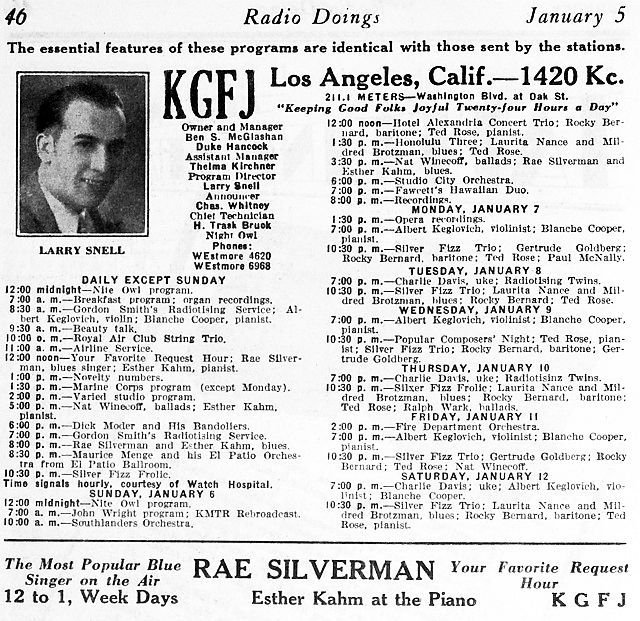
was called the "Kemper Nite Owl Program," likely named after the
main sponsor of the recorded music program. No announcer for this show was listed.
By October of 1929, KGFJ was simulcasting several shows with KFOX-Long Beach, including
the overnight "Nite Owl Program," which started at 1:00 AM. each
day after the Apex Nite Club remote at midnight. Radio listings show that M.B. Cosby was KGFJ's
"Resident Nite Owl" and likely the announcer on the overnight show. Being the only station in the entire
nation to stay on the air all night brought fame to KGFJ and an increase in listeners
throughout the years. After all, no other station in L.A. or anywhere else in the
USA then stayed on after midnight regularly. When he started this new idea of all-night
broadcasting 7 days a week in 1927-1928, McGlashan was quoted in Radio Doings
Magazine in 1930 as saying, "Nobody else would be crazy enough to
do it." In 1929, a few other radio stations
in Los Angeles followed KGFJ's lead, by playing records overnight. The radio
page of a Glendale newspaper dated April 17, 1929 lists KGFJ, along with
KMIC-Inglewood and KGFH-Glendale as broadcasting phonograph records from
midnight to 7:00 AM. In addition, KPLA in Los Angeles stayed on the air with
music from phonograph records from 1:00 to 6:00 AM. Just a few months later, KGFH went off the
air for good when the Federal Radio
Commission denied their station license renewal. And by the end of the year,
KPLA was sold to Earle C. Anthony and became KECA. The
1930’s and Beyond By 1932, at the depth of the Great Depression,
KGFJ was operating in the black. It had moved
into new quarters, with studios and offices on the top of the J.V. Baldwin
Building in Los Angeles at 1417 South Figueroa Street. It had a staff of 50, a
22-piece studio orchestra, and a long list of satisfied advertisers who paid
cash in advance for their airtime. Its modern Western Electric transmitter and
antenna remained at Washington at Oak St., where it stayed until January 14,
2009, nearly 82 years. (Until January 14, 2009, it was the last “flat-top”
antenna still in use in the country.) By March 8, 1935, KGFJ’s ´Night
Owl´ Program from midnight to 6 a.m. had new competition in Los Angeles, as
KFAC-1300 went to a 24-hour a day schedule with its “Kennel Club” from
midnight to 7:00 AM. And on 780 kHz, KTM was on the air until 4:00 AM, at which
time KELW took over the frequency until 6:00 AM broadcasting a popular Spanish
language program. By 1938, KGFJ and KFAC were the only
two Los Angeles radio stations broadcasting 24 hours a day. However, KFAC took
a two-hour silent period on Wednesday mornings from 3:00 to 5:00 AM, possibly
for maintenance. All other L.A. stations
at this time were off the air at midnight or 1:00 AM. The radio logs in the Los
Angeles Times show that by June 1, 1938, KGFJ and KFAC were joined during
the overnight hours by KRKD with “Midnight Express” from midnight until 6:00
AM, and KFVD played records until 4:00 AM with “Jack the Bellboy.” These three
stations continued their all night shows on L.A. radio through the end of 1939,
although KRKD-1120 did not operate 24 hours - it shared 1120 kHz with KFSG at
Angelus Temple, which was on the air weeknights from 7 pm to midnight as well
as Sunday services. In 1938, Calvin Smith left KGFJ to work
for E. L. Cord as the station manager at KFAC. (He kept that job with KFAC, until
Cord sold KFAC AM and FM for $2 million in December of 1962.) After Smith left KGFJ,
an older ham radio friend of McGlashan, H. Duke Hancock, served as KGFJ's assistant
manager for many years. Hancock had operated a "wireless radio station"
at the end of the Venice Pier as early as 1912. Thelma Kirchner (1904-1991), who had been
with KGFJ since 1927, eventually became the general manager of KGFJ in 1942, and was possibly one of the
first women to hold that job at a radio station. She had that title until
the station was sold in 1964. As the Depression years of the 1930’s
progressed, McGlashan filled the KGFJ airwaves with other types of programming
from midnight to 6:00, which made those overnight hours profitable for him. He played
syndicated sponsored transcriptions. According to radio historian Elizabeth
McLeod, this was a precursor to the more recent use of infomercials as
overnight paid filler programming on cable television. In fact, McLeod went on to tell me
that much of the KGFJ broadcast day at the time (1931-1934) consisted of
records, paid broadcasts by various ministers and fringe politicians, and 15-,
30- or 60-minute transcribed ads for weight loss scams, laxatives and other
obscure merchandise. Many of these KGFJ advertisers were occasionally mentioned
in a column in Broadcasting magazine entitled "Station
Accounts." Despite this shady type of
programming, which was commonly heard on other L.A. stations in the 1930s, the
fact that it was the only station on the air around the clock attracted attention
and made KGFJ popular with night-owls, overnight workers, insomniacs and
late-night DX enthusiasts. Because it was the only station broadcasting on 1200
kHz overnight, letters reporting reception of KGFJ's signal poured in from
every part of the U.S. On March 29, 1941, KGFJ moved to 1230
kHz. In 1947, its transmitter power was boosted on the Class IV/local frequency
(now known as Class C) to 250 watts day and night ; to 1,000 watts day/250 night
in 1962; and then in 1984 to 1,000 watts day and night. However, from 1947 to 1986,
KGFJ had to reduce its power to 100 watts to protect 100-watt KPPC in Pasadena,
also operating on 1240 kHz on Wednesday nights and Sundays from 6:00 AM to midnight.
(The Pasadena station on 1240 kHz was only 10 miles from the KGFJ transmitter, and
was licensed in 1924 before the FCC was in charge of regulating radio, so KGFJ was
obligated to “power down” twice a week, in order to prevent interfering with KPPC’s
signal.)
The
1950's saw KGFJ dividing its programs into block segments. Daytime
programs consisted of music with hourly newscasts. The "Night Owl" program continued to be heard overnight. In
1955, KGFJ began programming R&B and gospel music in the evenings,
targeting a black audience. By 1958, that was increased to a
full-time station format. In August, 1964, Ben McGlashan sold
KGFJ for $1.5 million to Richard B. Stevens, operating as the Tracy
Broadcasting Co. Stevens implemented a
new format of R&B, classic soul, and gospel music, and it became one of the
top three rated black stations in the country. The studios at that time were located at 550
Melrose Avenue. Popular disc jockeys in
these years included Hunter Hancock, Lucky Pierre, Larry McCormick and the
Magnificent Montague. Pat (Patricia) Newman hosted a Sunday morning talk show
called, "Pat's Points". Others
heard on KGFJ in the 1960s were Johnny Magnus, Rudy Harvey, Herman Griffith,
Curtis Troupe, Jim Randolph, Tom Reed, Roland Bynum, Frankie Crocker, Johnny
Soul (Ron Samuels) and Russ O'Hara. On October 10, 1977, The call sign
was changed to KKTT (“The Katt”), thought to be a more “hip” identity. Then in February, 1979, the station was sold
to Inner City Broadcasting Co. for $5.3 million, and the call letters were changed
back to KGFJ. In 1986, General Manager
William Shearer purchased the station for $4.5 million. He in turn sold it in 1995 to Personal
Achievement Radio Inc. (N. John Douglas, president/owner) for $5.5
million. The call sign was changed to
KYPA, standing for “Your Personal Achievement”, and the station broadcast a
personal improvement talk format for a few years before reverting back to an
R&B format. Today, KYPA broadcasts in the Korean
language, and is owned by Woori Media Group, LLC . It transmits from the facilities
of co-owned KBLA northwest of Dodger Stadium, using a two-tower directional
pattern day and night.
|